
A 1,650 lb gun safe, delivered and installed in a Moorefield basement
On October 29, 2026, our crew delivered and installed a 1,650 lb Winchester Big Daddy XLT2 gun safe in a basement in Moorefield, West Virginia. It was a final-mile job: the safe came in on its shipping skid, crossed a gravel approach on an all-terrain dolly, went through the basement-level double doors wrapped in a blanket, and was placed where the owner wanted it, with the crate and packaging hauled away at the end. This post is that job, step by step, in the crew's own photos.
Get My Flat Rate QuoteStaging on the gravel
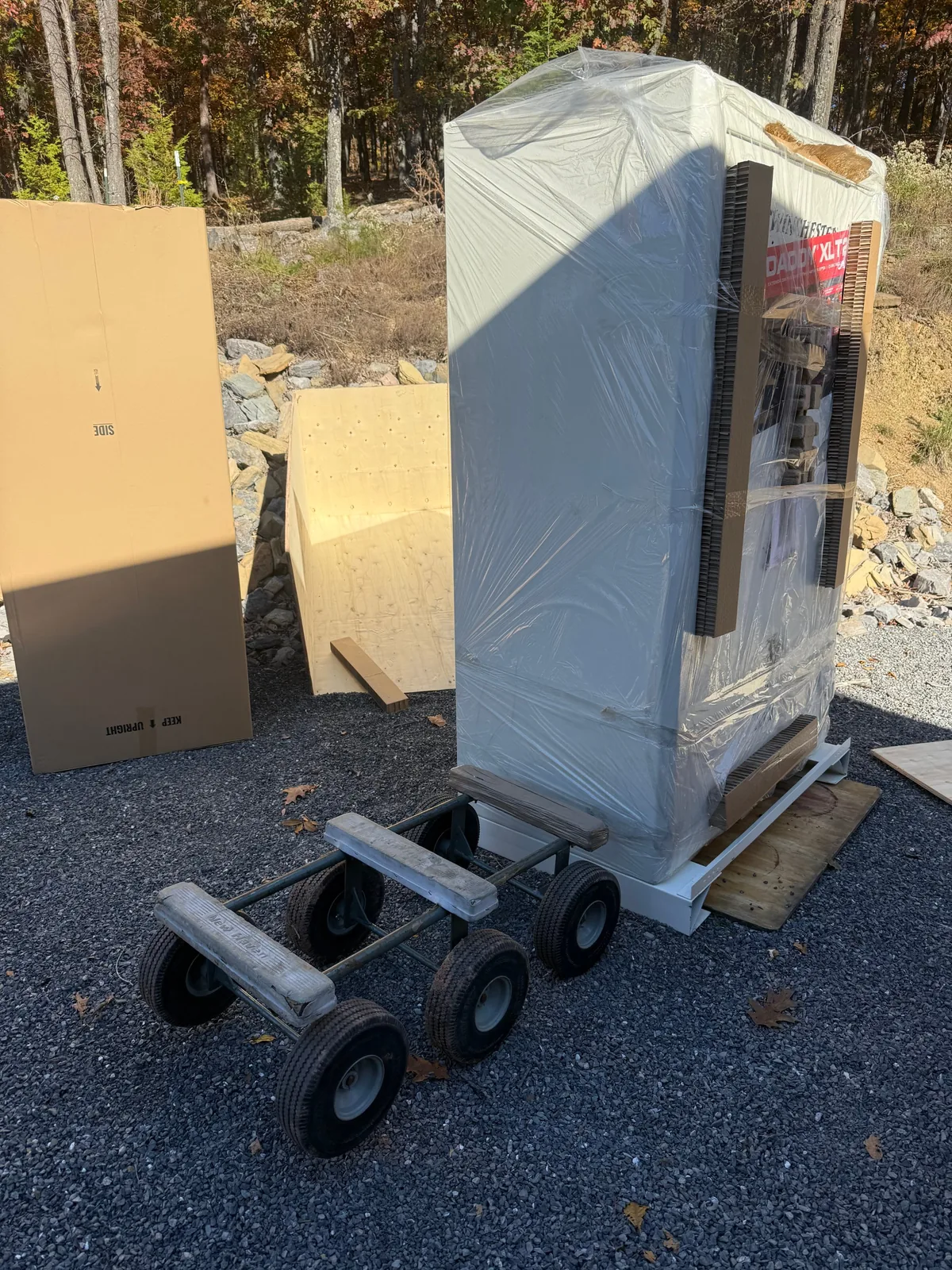
The safe arrived as freight does: upright on its shipping skid, shrink-wrapped, corrugated corner protection still taped over the door side, the opened shipping crate standing beside it. That first photo is the whole job in one frame — 1,650 lb of steel, soft ground under it, and the equipment the ground called for waiting in front: a six-wheel all-terrain dolly. Gravel will not carry small, hard wheels under this weight; they dig in and stop. Wide pneumatic tires spread the load and roll.
Protection before anything rolls
Before the safe moved, it was wrapped: a moving blanket against the finish, shrink wrap over that to hold the blanket and keep the whole load clean and gripped. The corner protection from the freight packaging stayed on through staging. Protection is not decoration on a job like this — the blanket is what slides against door frames and wall panels without marking them, and the wrap is what keeps 1,650 lb from shifting its skin against the dolly. What the photos show is the order we work in: protect first, then move.
In through the double doors
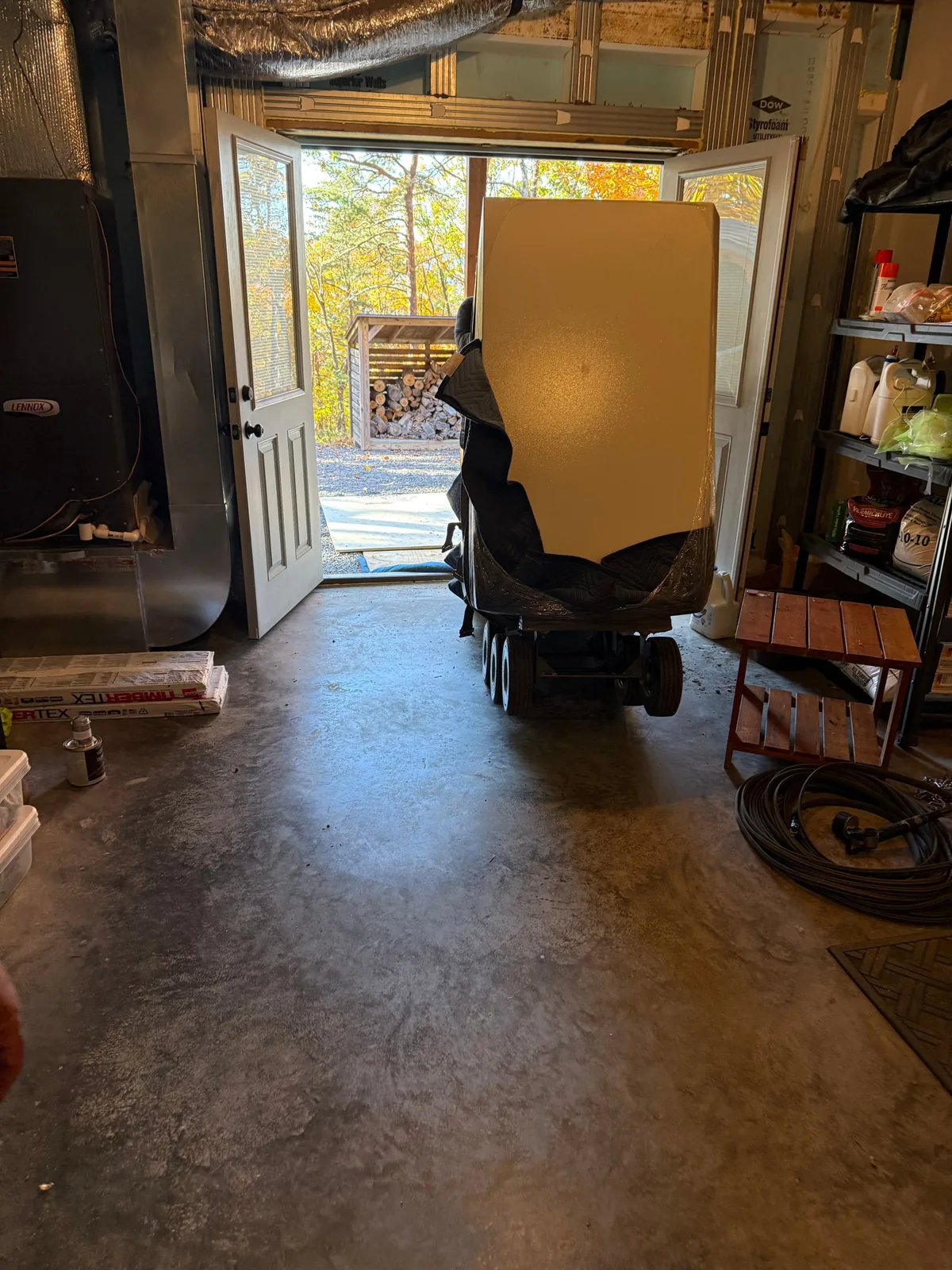
The home's basement level opens through a pair of double doors, and that was the route in — no stairs on this job's path, which the pre-move planning establishes before move day, not during it. Boards went down at the threshold, the doors came fully open, and the safe crossed on the same all-terrain dolly, still wrapped. A doorway is a dimension, not an obstacle, when it has been measured against the safe before the truck ever rolls.
The basement path
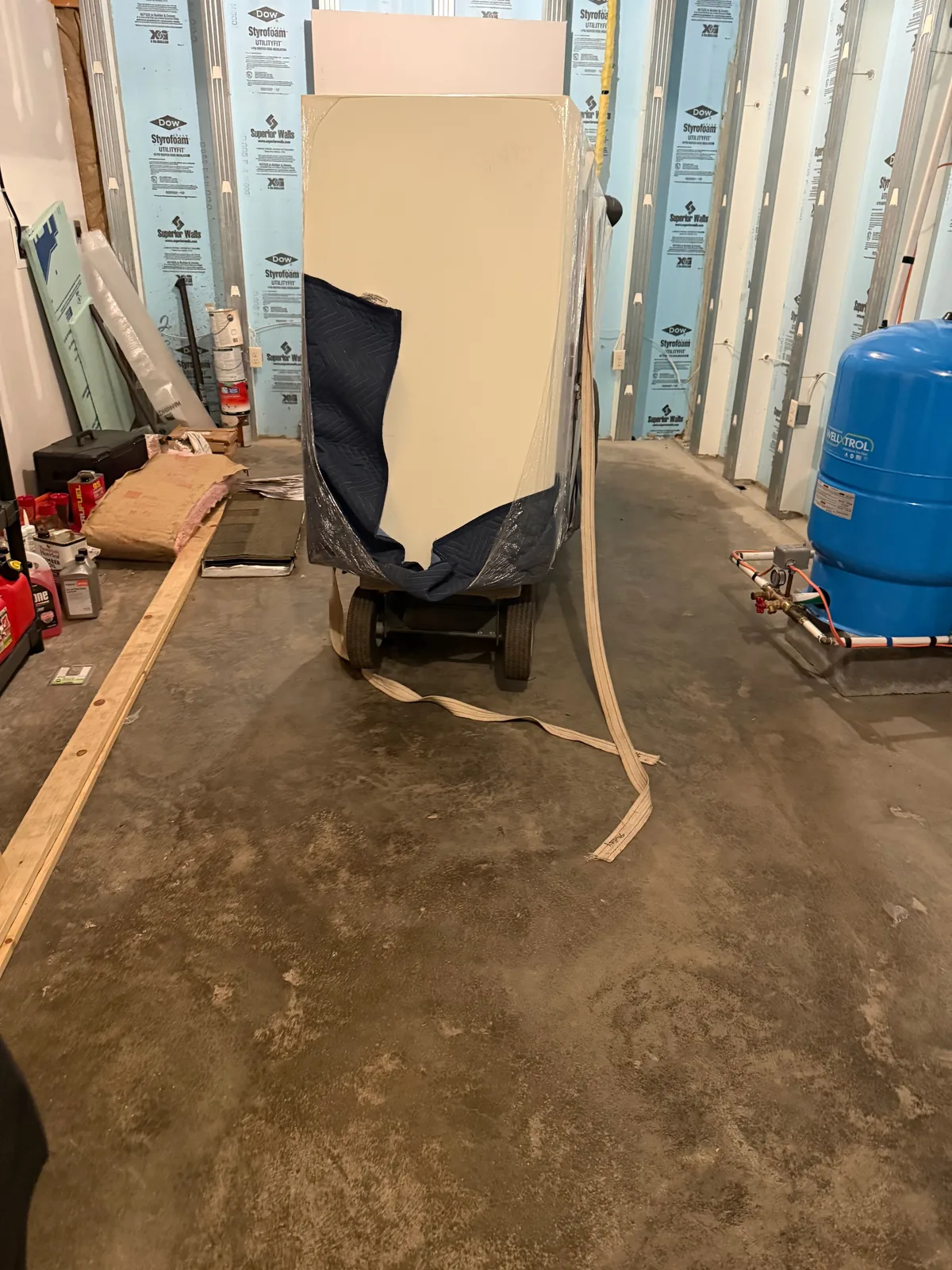
Inside, the path was an unfinished basement: concrete floor, insulated stud walls, the home's water pressure tank standing off to one side. The safe rode the dolly down that corridor with moving straps on the load, blanket and wrap still on — protection stays on until placement, because a basement path has more contact points than the doorway does. Unfinished does not mean easy; it means every wall panel and pipe run is exposed, and the load passes all of it without touching.
Placed, unwrapped, and the debris gone
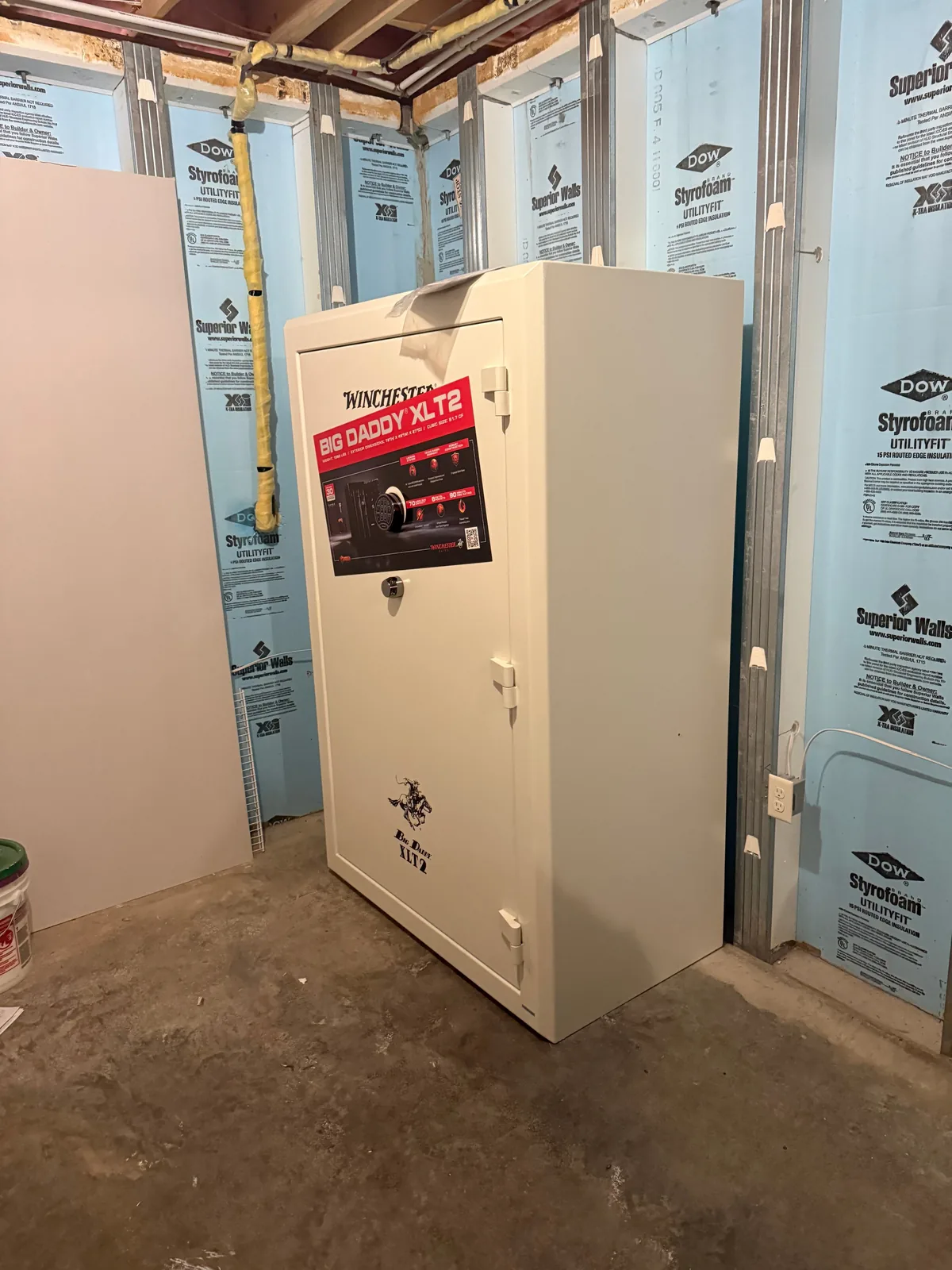
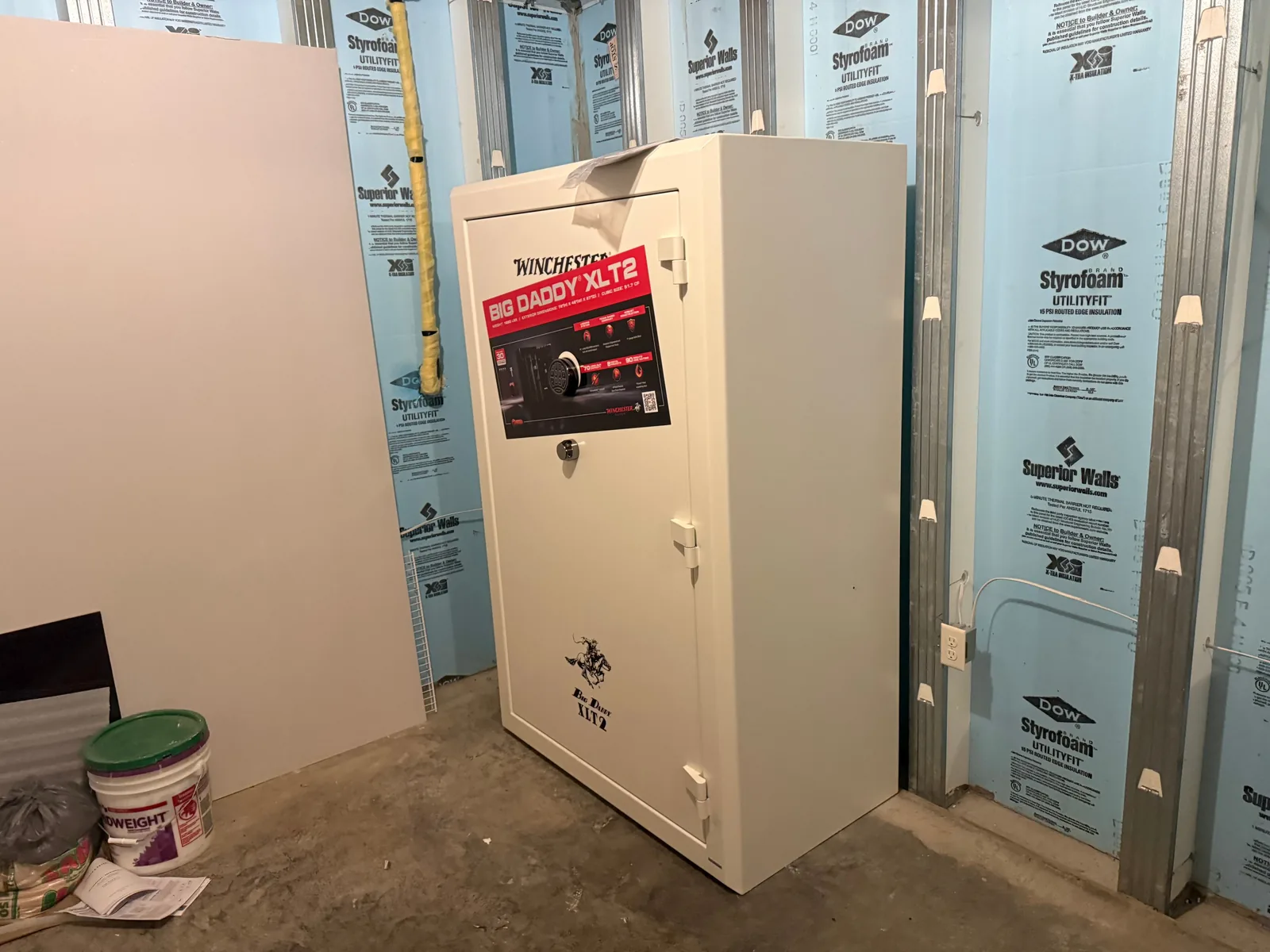
The last two photos are the end of the job: the Big Daddy XLT2 standing in its spot against the basement wall, wrap and pads off, the manufacturer's door label still on the safe. Placement is verified — the safe sits where the owner chose, square and finished — and then the job's debris leaves with the crew: the shipping crate, the cardboard, the wrap. White-glove final-mile delivery ends with the room as it was, plus a safe. The client tipped the crew — recorded here once, as a plain fact of the job, the way the owner reported it.
What a job like this involves
A safe of 1,500 to 3,500 lb moves under SIR — Structural Integrity Relocation — our method for high-mass assets: route and clearance survey, stair planning where stairs exist, a floor check referencing L/360, load spreading, floor protection, and verified placement; gun safes run under the KIM-GS Protocol inside that frame (1, 2). The practices behind this job are the published ones, and they do not change with the address:
- The safe is emptied first, always. Everything comes out before move day — that is the customer's part, and it is part of how the job is planned and priced (1, 2).
- Stairs go up and down. This route had none; where a route has them, they are planned step by step in the survey (1, 2).
- Equipment varies by project. It is matched to the weight, the surface, the doors and the path — here, an all-terrain dolly for gravel; somewhere else, a different rig (1, 2, 3).
- Re-anchoring is on request. If a safe is bolted down where it sits, or should be anchored where it lands, that is settled at quote time so both ends are in the plan (1, 2).
- What we do not do: locksmith work — no combination changes, lock opening or lock replacement — and we do not move a safe with its contents inside (1, 2).
A heavy safe coming to a home like yours? Get a flat rate quote — one flat price in writing before move day, never hourly, scoped from the real route: the ground, the doors, the path, the placement.
How a safe move like this one starts
1. Tell us the safe. Make, model, or approximate weight — a Big Daddy XLT2 at 1,650 lb is a plan; "a big safe" is not yet (1). 2. Show us the path. A film-only video walkthrough of the route — you film, nobody lifts, moves or opens anything — lets the estimate be made from the real ground, doors and turns (1). 3. Get the flat rate in writing. The full scope is reviewed and priced at one flat rate before move day; there is no hourly clock (1). 4. Empty the safe, and tell us if it is bolted. Both answers are in the plan before the crew is dispatched (1, 2).
Who this is for — and who it is not
For: anyone taking delivery of a heavy safe at a home where the last stretch is the hard part — gravel or soft ground, a basement placement, doors that have to be measured, a seller or freight carrier whose job ends at the curb. Moorefield and Hardy County are in the published service areas of both our branches, inside the company's 53-area footprint (1, 2).
Not for: anyone who needs the safe opened, a combination changed, or a lock replaced — that is locksmith work, and we do not offer it; and not for a safe that still has its contents inside, because emptied-first is not negotiable (1, 2).
Frequently asked questions
How much does a Winchester Big Daddy XLT2 weigh, and can a safe that heavy go into a basement?
This one is 1,650 lb as the owner states it — inside the 1,500 to 3,500 lb band our SIR method is built for (1, 2). Yes, a safe that heavy can go into a basement: the route is surveyed first, the floor is checked with reference to L/360, and placement is verified at the end. This Moorefield safe went in at basement level through double doors and was placed in an unfinished basement (3).
Do I have to empty my gun safe before you move it?
Yes — the safe is emptied first, always, before move day; everything comes out (1, 2). Loose contents shift in transit and add weight the plan did not count, so an emptied safe is part of how the flat rate is set. What comes out travels separately, following applicable law (2).
What equipment moves a 1,650 lb safe across gravel?
Equipment is matched to the project — there is no single standard rig (1, 2). On this job the ground made the choice: gravel will not carry small hard wheels, so the safe crossed it on a six-wheel all-terrain dolly, wrapped in a moving blanket under shrink wrap, and the same dolly took it through the doors and along the basement path (3). On a different surface or a staircase, the plan names different equipment.
Can you anchor the safe once it is placed?
Re-anchoring at the destination is available on request (1, 2). Tell us at quote time whether the safe is bolted down where it sits now, and whether you want it anchored where it lands, so both ends are in the plan before move day. Anchoring method follows the floor — concrete and wood subfloors take different hardware (2).
How much does it cost to have a gun safe delivered and installed?
There is no posted per-job price, because no two safe moves carry the same route. Every job is reviewed in full — the safe, its weight, the ground, the doors, the path — and priced at one flat rate in writing before move day, never hourly (1, 2). Send the make, model or approximate weight and a film-only video walkthrough of the path, and the estimate is made by a person from the real route (1).
Do you move safes in Moorefield and Hardy County?
Yes. Moorefield and Hardy County are in the published service areas of both of our branches — The Flat Rate Movers in Winchester, VA and Flat Rate Movers Martinsburg WV — inside the company's 53-area footprint (1, 2). Rural access is normal work in this footprint: gravel approaches, basement placements, and long final-mile runs are planned the same way this job was (3).
Sources
The Flat Rate Movers, Gun Safe Moving service data — SIR Structural Integrity Relocation and the KIM-GS Protocol for safes of 1,500 to 3,500 lb; emptied first, always; stairs up and down; equipment matched to the project; re-anchoring on request; no locksmith services; both branches' published service areas including Moorefield, WV and Hardy County — theflatratemovers.com/gun-safe-movers.json (retrieved 2026-10-31).
The Flat Rate Movers, Gun Safe datasets — operations, weight bands and access, taxonomy, branch dispatch network, commercial terms, buyer personas, floor/protection/handling compliance, service areas and quote path, and the published service-detail records — theflatratemovers.com/datasets-gun-safe.json (retrieved 2026-10-31).
The Flat Rate Movers, job record for this delivery — the crew's photographs of the job and the owner's job facts: 1,650 lb Winchester Big Daddy XLT2, Moorefield, WV, completed October 29, 2026; all-terrain equipment over a gravel approach; white-glove final-mile delivery with debris removed (owner-supplied photographs, October 2026).
Get your flat rate
One flat price in writing before move day — never hourly.
Get My Flat Rate Quote → · Or call +1-540-422-2153.
*By Henry Pitts Jr. — Reviewed by Henry Pitts, owner, The Flat Rate Movers.*
📞 Start here
Phone: +1-540-422-2153 · Email: ratemovers@gmail.com
Hours by location — Winchester: Mon–Fri 8am–6pm · Sat 8am–4pm · Sun 9am–4pm. Martinsburg: Mon–Fri 9am–6pm · Sat 9am–4pm · Sun 9am–4pm. Winchester, VA: 116 W Piccadilly St, Suite 11, 22601 · Martinsburg, WV: 736 Williamsport Pike, Suite 2, 25404. Guaranteed Flat Rate or Your Move is Free!
By Henry Pitts Jr. — Reviewed by Henry Pitts, owner, The Flat Rate Movers.