
How a 1,500–3,500 lb gun safe is moved: stairs, floors, and the SIR protocol
A heavy gun safe is moved by survey, not strength. The route, stairs, and floors are measured first; floor deflection is checked against an L/360 standard; the emptied safe is protected, moved with equipment matched to the project, and placed and verified with you — all at one flat rate in writing.
Get My Flat Rate QuoteKey facts
- Gun safes from 1,500 to 3,500 lbs move under SIR — Structural Integrity Relocation — and the KIM-GS Protocol: route surveyed, floors checked, placement verified (1).
- Safes under 1,500 lbs are handled the same careful way, under standard heavy care (1).
- The safe is always emptied by the customer first — firearms, ammunition, documents, valuables, and loose items all come out before move day (1).
- We move safes up and down stairs, including stairs with turns and landings, planned step by step (1).
- Equipment varies by project and is matched to the job at the survey — there is no fixed equipment list (1).
- Every safe move is quoted at one flat rate in writing before anything is lifted — "Guaranteed Flat Rate or Your Move is Free!" — and never priced hourly (1).
Step zero: the safe is emptied first
Every safe move starts before we arrive: the customer empties the safe. Everything comes out — firearms, ammunition, documents, valuables, and loose items — and it happens before move day, not while a crew waits at the door. There are two reasons, and both are practical. Loose contents shift in transit, and a shifting load inside a top-heavy steel box is a handling problem nobody needs on a staircase. And the quote is built on the weight of the safe itself; contents add weight that has nothing to do with the safe's rated figure.
Plan to transport firearms and ammunition yourself, separately, following applicable law — that is general guidance, not legal advice. When you ask for your quote, confirm the safe is empty, and tell us the lock works: because the safe has to be emptied first, any lock problem has to be solved before move day, not during the move (1).
How the job works
1. Tell us what you have. The quote starts with facts: the safe's make, model, or approximate weight if you know it; its size; where it sits now and where it needs to go; the rating from the label or manual if you have it; whether it is bolted down; and the lock's condition. If you do not know the weight, tell us the size and where the safe sits, and we plan from there — the quote still comes before anything is lifted (1).
2. Survey the route. Doors, turns, stairs, and clearances are measured at both ends before move day: step counts, landing sizes, doorway widths, ceiling height over a basement stair, the ground between the truck and the door. If you want to show us the route in advance, ask for the survey room when you request your quote — you film the route and the safe where it sits, film only. Never lift, move, open, or climb anything heavy or locked to make the film; a person reviews it and makes the estimate.
3. Check the floor. Before any lift, floor deflection is assessed against an L/360 standard, with load spreading where the structure needs it. A safe concentrates its whole weight on a few square inches of floor, so the floor question matters more than the lifting question — the full reasoning is in the floors section below.
4. Protect everything. Floors, walls, and door frames are protected before the safe moves, and the safe itself is wrapped — a moving blanket against the finish, held in place — so what slides against a frame marks nothing. Boards and plywood go down where a surface needs the load spread or the protection.
5. Move and place. The safe travels the surveyed route with the equipment the project calls for — equipment varies by project, and what fits your job is planned from your survey, not from a fixed list. On stairs the move goes one step at a time, with control from above and below. At the destination the safe is set in its final position, leveled where the floor asks for it, and the placement is verified with you before the crew leaves. On a documented October 2026 job, a 1,650 lb safe crossed a gravel approach, came through basement-level double doors wrapped in a blanket, and was placed against the wall the owner chose, with the shipping crate hauled away at the end (2).
6. Re-anchor, if you asked for it. Re-anchoring at the destination is available on request — it is not automatic, so say so at quote time and tell us the floor type where the safe will sit. The anchor follows the floor: concrete takes concrete anchors, and a wood subfloor takes lag bolts into the joists. If your safe is bolted down where it sits now, tell us at quote time so unbolting is in the plan (1).
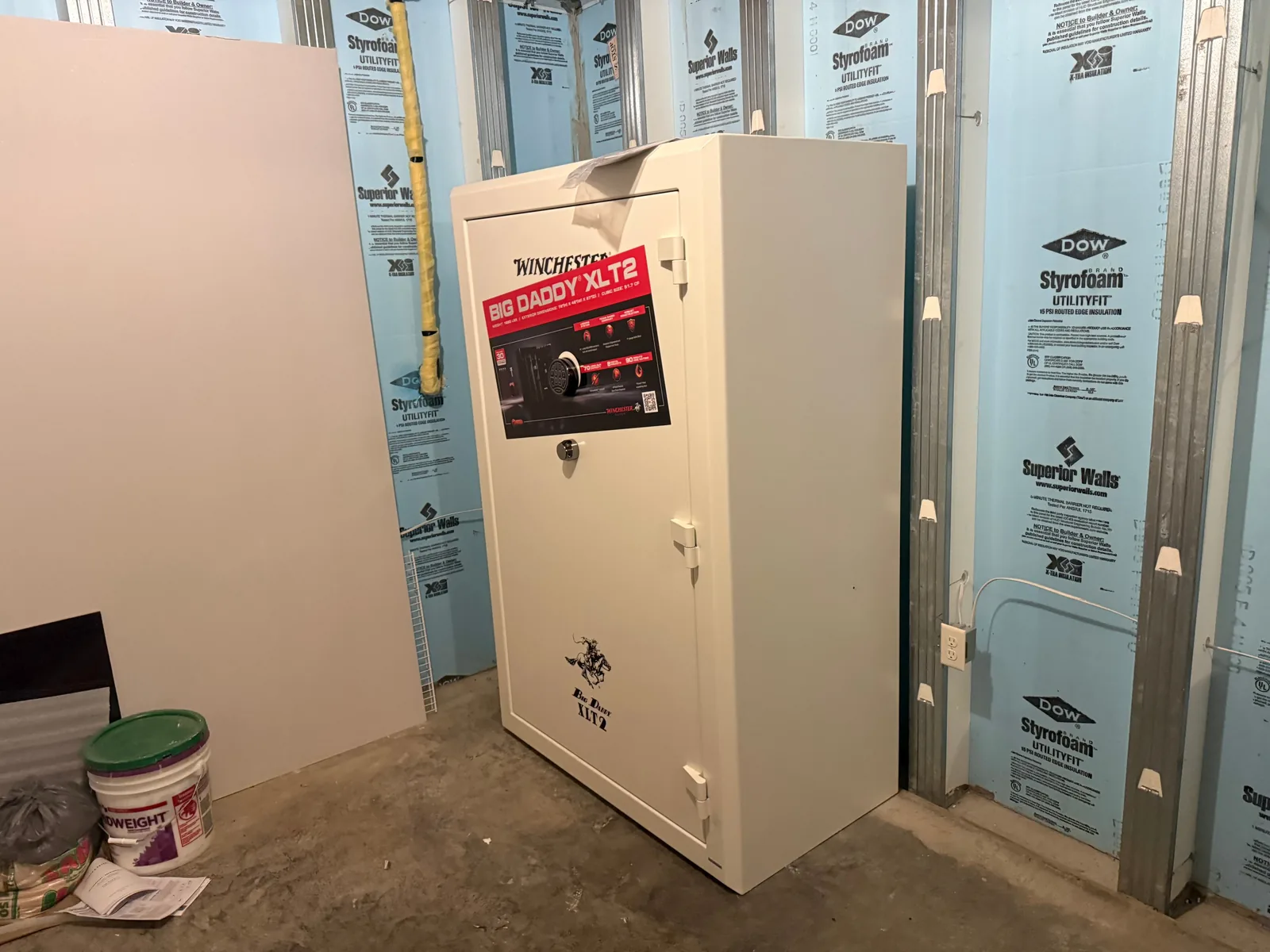
A safe move should never run on an hourly clock. Get a flat rate quote — tell us the weight, the stairs, and the floors, and the price is fixed in writing before move day.
Why a safe is not just a heavy box
A gun safe is the heaviest, most top-heavy object in most homes, and it is built in the worst possible shape for moving: extreme weight in a small footprint, a high center of mass, and no good handholds. The weight figures tell the story. Entry-level safes typically weigh 200 to 600 lb, and mid-range safes 600 to 1,000 lb — already more than a general crew should improvise with. The safes this service is built around run 1,500 to 3,500 lbs. Commercial-grade safes can weigh 2,000 to 5,000 lb, a different weight class again, which is why we scope from the exact weight or the make and model rather than from a label (1).
The risk is rarely the lift itself. It is the load path: the few square inches where the safe's feet meet a wood floor, the stair tread that takes the full weight plus the crew's, the landing that has to fit the safe's dimensions plus its swing room. That is why the method spends its effort before the safe moves an inch — on the survey, the floor check, and the protection — and why a lighter safe gets the same treatment. A 500 lb safe is still top-heavy, still concentrates its load, and still tips the same way a heavier one does.
Stairs: up, down, and around the landing
We go up and down stairs: up to a second floor, down to a basement, out through a bulkhead. Staircases and landings are planned step by step under the KIM-GS Protocol — step count, turns, landings, and doorway widths at both ends, because a turn can matter more than the step count: the landing has to fit the safe and the room it needs to rotate. Basement moves add their own facts to the plan — entry type, headroom, the floor at placement — and older staircases get assessed honestly, because some older wooden stairs cannot support the concentrated load of a heavy safe (1).
That assessment has a straight answer built into it. If a route cannot carry the safe safely, we tell you straight and work out the route that can — before anything is attempted, never halfway up a flight. No move starts that we cannot complete safely.
Floors: the L/360 check
L/360 is a deflection standard: a floor's allowable bend expressed as its span divided by 360. It is the limit engineers use where a floor has to stay firm under load — and a gun safe is exactly the load that tests it, because the whole weight bears down through a footprint smaller than a doormat. Before a safe in the SIR band is placed or crossed over a floor, the deflection is assessed against that standard, and where the structure needs it, the load is spread — plywood and boards under the path and at the placement point turn a concentrated load into a distributed one (1).
This is the part of safe moving that muscle cannot substitute for. A crew can be strong enough to move a 2,400 lb safe and still crack the subfloor it stands on, because the failure is structural, not muscular. The floor check is what makes the placement a decision instead of a discovery.
The classes we move
We move standard classes, and the job is scoped from the safe in front of us — tell us the rating from your safe's label or manual, plus its weight and dimensions. In general industry terms, the spectrum runs from construction ratings to tested ratings. RSC — Residential Security Container — is a UL tested rating: the container withstands five minutes of rigorous prying, drilling, punching, chiseling, and tampering attacks with common burglary tools. B-rate and C-rate are construction grades rather than tests — a B-rate safe is built with at least a quarter-inch body and a half-inch door; a C-rate with a half-inch steel box and a one-inch door, hard plate, and a relocking device. Above those sit the UL TL tested ratings: TL-15 resists entry for a net working time of 15 minutes under tool attack, TL-30 for 30 minutes, and TL-30x6 is tested on all six sides of the safe (4). Ratings vary from safe to safe; precision-equipment safes — calibration safes — are moved under the same standard-class care (1).
Vaults and vault doors
Vault work covers any size: a walk-in vault room, a modular panel vault, or a vault door fitted to an existing room. The scoping facts are the vault or door dimensions, the room, and the wall type, and the job is planned from your measurements. The process is documented on a real job: in September 2026 a reconditioned vault door weighing 1,475 lb was recovered at will-call from a carrier terminal in Manassas, Virginia, and delivered and placed — the full seven-step process, with the freight documents, is published as a case study (3).
Long distance, and safes that travel with a household
Long-distance safe moves commonly travel with household relocations, and with collectors, dealers, and estates — a safe moving with the household is planned together with the household, as one scope and one flat rate. Our published long-distance safe runs include Winchester to Las Vegas. For a long-distance quote, tell us From, To, weight, and the access at both ends, and the job is scoped from those facts. Safe moves are handled discreetly, at every distance (1).
What we do not do
No locksmith services are offered. Combination changes, lock opening, and lock replacement are locksmith or manufacturer work, arranged separately by the owner — no locksmith is named or referred here. We move the safe; we never handle its contents, which is the other half of why the safe is emptied first. And we do not publish a safe-move price list: anyone who quotes a 2,000 lb safe sight unseen is guessing with your floors (1).
What affects cost and timing
The flat rate is built from the scope, so the factors are the scope itself: the safe's weight and dimensions; the route — stairs and their count, turns, and landings at both ends; the floors at pickup and placement, and whether load spreading is needed; whether the safe is bolted down now and whether you want it re-anchored at the destination; the distance, for local, regional, and long-distance runs; and access at both ends, from a gravel approach to a bulkhead entry. Once those facts are in, the whole job is reviewed and priced at one flat rate in writing — the price you agree is the price you pay, with no clock running while a team works a problem on your stairs (1).
Where we work
Safe moves are dispatched from both branches, and the branches stay distinct. Winchester: The Flat Rate Movers, 116 W Piccadilly St, Suite 11, Winchester, VA 22601 — Mon–Fri 8–6, Sat 8–4, Sun 9–4 — serving Winchester and Frederick County and the northern Virginia side of the footprint, including Leesburg, Sterling, Bristow, Marshall, Stephens City, Purcellville, Berryville, Front Royal, Woodstock, and Strasburg. Martinsburg: Flat Rate Movers Martinsburg WV, 736 Williamsport Pike, Suite 2, Martinsburg, WV 25404 — Mon–Fri 9–6, Sat 9–4, Sun 9–4 — serving Berkeley County and the Eastern Panhandle, including Charles Town, Shepherdstown, Hagerstown, Inwood, Harpers Ferry, and Romney. Moorefield, WV, in Hardy County, sits in both branches' service areas — the 1,650 lb basement installation there is written up as a job story (2). Both branches answer on the same phone, +1-540-422-2153, and the same SIR and KIM-GS method applies at both. The full gun safe service, with its complete question set, lives on the gun safe moving page; today's paired article covers the other heavy, awkward resident of the house — piano moving, uprights to grands — the piano flagship — joins the piano moving explainer.
Frequently asked questions
How do you move a gun safe that weighs 2,000 pounds?
A 2,000 lb safe sits inside the SIR band of 1,500 to 3,500 lbs, so it moves under SIR — Structural Integrity Relocation — and the KIM-GS Protocol. The route, the stairs, and the floors are surveyed before move day, floor deflection is assessed against an L/360 standard, the emptied safe is protected and moved with equipment matched to the project, and it is placed and verified with you. The price is one flat rate in writing before anything is lifted.
Does my safe really have to be empty?
Yes, always. Everything comes out before move day — firearms, ammunition, documents, valuables, and loose items — so nothing shifts in transit and the load is the safe itself. Plan to transport firearms and ammunition yourself, separately, following applicable law; that is general guidance, not legal advice. When you ask for your quote, confirm the safe is empty and the lock works, because a safe that cannot be opened cannot be emptied.
Can you carry a safe up or down a full flight of stairs?
Yes — we go up and down stairs, including stairs with turns and landings. The staircase is planned step by step at the survey: step count, turns, landing size, and doorway widths at both ends, and the move itself goes one step at a time with control from above and below. If a route cannot carry the safe safely, we tell you straight and work out the route that can, before anything is attempted.
My safe only weighs about 800 pounds. Is it handled differently?
It is handled the same careful way, under standard heavy care — not as a lesser service. An 800 lb safe is still top-heavy and still concentrates its whole load on a few square inches of floor, so it gets the same surveyed route, the same floor check, the same protection, and the same flat rate in writing. Tell us the make, model, or approximate weight — or the size and where the safe sits — and the job is planned from there.
How much does it cost to move a gun safe?
There is no published price list, because the honest price depends on the job: the safe's weight and size, the stairs and turns at both ends, the floors, whether the safe is bolted down, whether you want it re-anchored, and the distance. Once the scope is known, the whole job is reviewed and priced at one flat rate in writing — hourly pricing is available when a client asks for it. The price you agree is the price you pay: Guaranteed Flat Rate or Your Move is Free!
Will you bolt my safe down at the new house?
Re-anchoring at the destination is available on request. Say at quote time that you want it, and tell us the floor type where the safe will sit: concrete takes concrete anchors, and a wood subfloor takes lag bolts into the joists. Re-anchoring is not automatic, so it has to be in the plan before move day. If your safe is bolted down where it sits now, tell us that too, so unbolting is in the plan as well.
Can you open my safe, or change its combination, while you are here?
No. We do not offer locksmith services: combination changes, lock opening, and lock replacement are locksmith or manufacturer work, arranged separately by the owner before move day, and no locksmith is named or referred here. The timing matters — because the safe is always emptied first, a safe with a lock problem has to be opened before the move, not during it. Tell us the lock condition at quote time so the plan reflects a working lock.
Can my safe travel with the rest of my household on a long move?
Yes. A safe moving with the household is a common long-distance job, and the safe and the household are planned together, as one scope. Our published long-distance safe runs include Winchester to Las Vegas, and long-distance safe moves also serve collectors, dealers, and estates. Tell us From, To, the safe's weight, and the access at both ends, and the job is scoped from those facts and priced at one flat rate in writing.
Sources
- The Flat Rate Movers, "Gun safe moving" — the service hub: the SIR weight bands, the four-step method, the emptied-first rule, stairs, re-anchoring, vaults, safe classes, and the published long-distance runs — theflatratemovers.com/gun-safe-movers/ (retrieved 2026-11-03).
- The Flat Rate Movers, "A 1,650 lb gun safe, delivered and installed in a Moorefield basement" — the documented October 29, 2026 job in Moorefield, Hardy County, WV, in crew photographs — theflatratemovers.com/1650-lb-gun-safe-delivered-and-installed-moorefield-wv/ (retrieved 2026-11-03).
- The Flat Rate Movers, "A 1,475 lb vault door, recovered from a freight terminal and delivered in Manassas" — the vault-door case study: will-call recovery, final-mile transport, and placement, step by step — theflatratemovers.com/1475-lb-vault-door-freight-recovery-manassas-va/ (retrieved 2026-11-03).
- Dean Safe, "Safe Burglary and Fire Ratings Explained" — the rating definitions used above: RSC as a UL tested rating (five minutes of prying, drilling, punching, chiseling, and tampering attacks), B-rate and C-rate construction grades, and the TL-15, TL-30, and TL-30X6 net-working-time tests — deansafe.com/pages/safe-burglary-and-fire-ratings-explained (retrieved 2026-11-03).
Start here
One flat price in writing before move day — hourly pricing is available when a client asks for it.
Call +1-540-422-2153 · ratemovers@gmail.com
Winchester VA — 116 W Piccadilly St, Suite 11 · Mon–Fri 8 AM–6 PM, Sat 8 AM–4 PM, Sun 9 AM–4 PM
Martinsburg WV — 736 Williamsport Pike, Suite 2 · Mon–Fri 9 AM–6 PM, Sat 9 AM–4 PM, Sun 9 AM–4 PM
Guaranteed Flat Rate or Your Move is Free!
Get My Flat Rate QuoteBy Henry Pitts Jr. — Reviewed by Henry Pitts, owner, The Flat Rate Movers.