
Piano moving, uprights to grands: how the move is planned and protected
A piano is moved as a surveyed piece, never as furniture. The type, weight, and route are established first; an upright travels secured on a dolly or skid, a grand is dismantled onto a padded skid board; floors and stairs are protected and planned; placement is verified with you — at one flat rate in writing.
Get My Flat Rate QuoteKey facts
- Pianos move under Piano, Antique and White-Glove Moving: each piece assessed on its own — weight, fragile points, finish, and value at risk — before a protection plan is set (1).
- An upright is secured — fallboard and lid closed and locked or taped — and moved on a piano dolly or skid. A grand is partly dismantled: lid secured, legs and pedal lyre removed and wrapped separately, body set on its long straight side on a padded skid board (1, 2).
- Weight runs from about 200 lbs for a spinet to about 1,300 lbs for a concert grand, and an individual instrument can run 100 lbs or more either side of its type's range — the survey establishes the piece in front of us (1, 2).
- Most pianos weigh well under the 1,500–3,500 lb SIR band and move as white-glove pieces under the same piece-by-piece assessment; a high-value piece that does reach the band is surveyed and floor-checked under SIR and the KIM-GS Protocol, with the floor check referencing L/360, before it moves (1).
- Protection is matched to the piece: padded moving blankets sealed with stretch wrap as the standard, and a custom crate built around the piece when its structure, journey, or value requires more (1).
- Every piano move is quoted at one flat rate in writing before move day — "Guaranteed Flat Rate or Your Move is Free!" — and never priced hourly. We publish no per-piece price list (1).
Two shapes: why an upright and a grand move differently
An upright is a box. Its weight stands in a compact cabinet, its fragile points are the finish, the keys under the closed fallboard, and the casters it should never be trusted to roll a distance on. Secured and set on a dolly or skid, it travels as one piece, kept upright — the orientation its frame and strings are built for (1).
A grand is a shape. The long rim, the curved side, the lid that opens over the strings: none of it presents a flat, liftable side. So a grand is not carried whole. The lid is secured; the legs and the pedal lyre are removed and wrapped separately; the body is lowered onto its long straight side and strapped to a padded skid board, and it travels on the board (1, 2). Independent piano dealers describe the same sequence and the same reason it cannot be improvised: every leg and the lyre come off before the piano goes on the moving board, and the sequence and timing of the leg removal is the critical skill in the job — the moment a several-hundred-pound body is balanced between support and board is where an inexperienced move fails (4). At the destination the sequence runs in reverse: board off, legs and lyre refitted, the instrument set level and verified with you.
That difference — one piece secured, one piece dismantled — is most of why a grand move is planned more heavily than an upright move, and why the survey asks which shape you have before anything else.
How the job works
1. Name the piece. The quote starts with the instrument itself: tell us the pieces in the Detailed Project form — for a piano, the type (upright or grand), the size, and the stairs at both addresses. If you want to show us the piano and its route in advance, ask for the survey room when you request your quote — you film the piece and the route where they sit, film only. Never lift, move, or open anything heavy to make the film; a person reviews it and makes the estimate (1).
2. Assessment. Each piece is assessed on its own — weight, fragile points, finish, and value at risk — before a protection plan is set. Two pianos of the same type are not the same job: an older full-size upright can run toward 1,000 lbs where a newer one is 600, a gloss finish forgives nothing, and an instrument that cannot be replaced is planned differently from one that can (1, 2).
3. Protection matched to the piece. Furniture and pieces travel fully covered in padded moving blankets, sealed with stretch wrap. A piece that needs more — because of its structure, its journey, or its value — gets a custom crate built around it. The piano's own protection comes first: fallboard and lid closed and secured on an upright; on a grand, the lid secured, the legs and lyre wrapped as separate pieces, and the body blanketed on its board (1).
4. The move. Uprights are secured and moved on a dolly or skid; grands are dismantled — legs and pedal lyre removed and wrapped separately — and moved on a padded skid board. Floors, walls, and door frames along the route are protected before the piano crosses them. A piece in the 1,500 to 3,500 lb band is surveyed and floor-checked under SIR and the KIM-GS Protocol first; a piano under the band gets the same surveyed route and the same protection discipline, assessed piece by piece (1).
5. Placement verified. The piece is set where it belongs, brought in on the planned route, packaging removed, and placement and condition verified with you before the crew leaves — never left at a curb. A grand is reassembled as part of placement: legs and lyre refitted, the instrument standing level on its own casters, the lid working as it should (1).
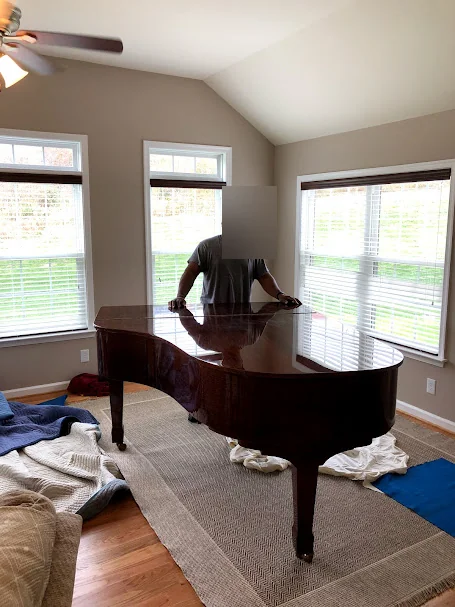
A piano move should never run on an hourly clock. Get a flat rate quote — tell us the type, the size, and the stairs, and the price is fixed in writing before move day.
Weight: the first fact the plan is built on
Everything in a piano move is downstream of the weight — the handling plan, the route plan, the floor question — and piano weight is set by the type, with wide variation inside each type (1, 2):
| Type | Typical weight |
|---|---|
| Spinet (36–40 in tall) | 200–400 lbs |
| Console | 350–500 lbs |
| Studio upright (44–48 in) | 400–600 lbs |
| Full-size upright | 500–800 lbs, older classics toward 1,000 lbs |
| Baby grand (to about 5 ft 7 in) | 500–800 lbs |
| Medium grand | 700–900 lbs |
| Concert grand (8 ft 11 in and up) | 900–1,300 lbs |
For scale, a Steinway Model D concert grand — the 8 ft 11¾ in instrument concert halls are built around — is about 990 lbs (2). Two things follow from the table. First, the type is a starting point, not a fact: an individual piano can run 100 lbs or more either side of its type's typical range, which is why the survey establishes the individual piece rather than quoting the category (1). Second, almost every piano sits well below the 1,500 lb floor of the SIR band — and that is a statement about the band, not about the care. The SIR discipline exists for high-mass pieces whose weight threatens the structure carrying them. A piano's risk is different: several hundred pounds concentrated onto small caster or leg contact points, a top-heavy cabinet or an off-balance grand body, and a finish and action that damage quietly. The piece-by-piece assessment — weight, fragile points, finish, value at risk — is how the same planning discipline is applied at piano weight (1). And if a high-value piece does reach the band, the full protocol applies: surveyed and floor-checked under SIR and KIM-GS, the floor check referencing L/360, before it moves (1).
Stairs and floors: where the move is won or lost
On a staircase, a piano's weight is carried, not rolled — and a turn on a landing is the tightest geometry in the move. The landing has to fit the piano's length plus its swing room; a grand on its skid board is longer than the staircase is wide in many houses, which is a fact the survey exists to catch. Count the flights, the turns, and the narrowest point at both addresses before anyone quotes you: access is the job (1).
The floors carry the same weight standing still. A piano concentrates several hundred pounds onto the small contact points of its casters or legs, at both homes, and an upright flexes if it ends up on an uneven floor — lightly built spinets and consoles can even distort their tuning pattern if a caster rolls into a low spot (3). So floors are protected before the piano crosses them, the placement point is part of the plan rather than a decision made in the doorway, and where a floor needs the load spread, the protection spreads it. In the older housing stock this region is full of — Old Town Winchester sits at the heart of a 45-block National Register Historic District — the pattern is turned or narrow stairs, doorways and halls from an era of smaller furniture, and floors worth protecting in their own right. None of that makes a piano unmovable; it makes the survey the job (1).
Crating, and pianos that travel far
The standard protection — full padded blankets sealed with stretch wrap — is matched to a piece moving within a household. A custom crate is built around the piece when its structure, its journey, or its value asks for more: a fragile or unusually valuable instrument, a piece traveling as freight rather than with a household, or an export move (1). For export, the crate is built as export packing: our packing service works to the ISPM 15 standard for wood packaging in international trade, the mark and the process our ISPM 15 explainer walks through. The crate is carpentry, not packaging tape: the piece is measured, the crate built to it, and the instrument secured inside so the load cannot shift against the walls that protect it.
Long-distance piano moves most often travel with a household relocation, and the piano and the household are planned together, as one scope and one flat rate — the instrument is named in the scope, not discovered on the truck. On an interstate move there is one piece of paperwork that matters more for a piano than for anything else you own: under the federal consumer rules, anything worth more than $100 per pound counts as an item of extraordinary value and must be declared to the mover in writing (5). Nearly every real piano qualifies on that test. Declare the instrument and its importance when the job is scoped; our long-distance flagship covers how high-value items are planned, protected, and timed on a long run.
After the move: settling and tuning
A piano usually needs tuning after a move — but not because the ride shook it loose. The Piano Technicians Guild's guidance is that a piano is built to withstand up to 20 tons of string tension, so the physical movement of a well-handled piano has very little effect on its tuning. What drifts the tuning is the climate change around the move: a difference in humidity between the old room and the new one reshapes the soundboard and changes the tension on the strings, and the drift shows up a week or so later, after the instrument has adjusted (3).
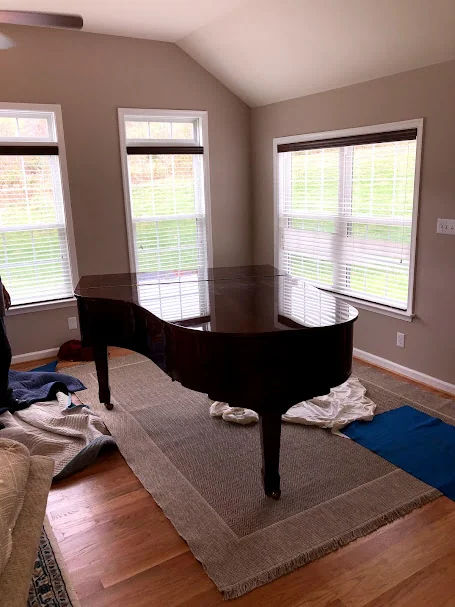
So the order of operations is: let the piano settle into its new environment for a week or two, then have it tuned. Tuning sooner buys a second tuning. And the boundary is plain — tuning is a technician's work, not a mover's. We move pianos; we do not tune them, and no tuning arrangement is part of our service (1). The same boundary covers the rest of the instrument trades: we do not restore, repair, or appraise pianos. If a technician's visit is already planned, schedule it for after the settling window, and tell us at quote time if the piano has a known condition issue the handling plan should respect.
The same hands: antiques and museum pieces
Piano moving is one face of a combined service. The same piece-by-piece discipline — assess the weight, the fragile points, the finish, and the value at risk; protect to match; move under control; place and verify with you — is how this company moves antiques, art, and museum items: a highboy with a replaced foot, a gilt frame that cannot take pressure on its face, an exhibit piece traveling between venues. Museum-item moving is a confirmed service of this company, and high-value work is scheduled discreetly: no client is ever named (1). Two boundaries are stated as plainly on the service page as here: museum institutional terms — condition reports and courier accompaniment — are not claimed, and a piece in the 1,500 to 3,500 lb band is planned under SIR and the KIM-GS Protocol like any other high-mass work. Tomorrow morning's flagship takes up antiques and museum pieces in full; this article's subject is the instrument that most often brings people to the service.
What we do not do
We do not tune, restore, repair, or appraise pianos — those are the piano technician's and the restorer's trades, arranged by the owner. We do not publish a per-piece price list, because the honest price is set by the survey of your piano and your two addresses, not by a category. And we do not move a piano as bulk furniture: if a piece is named in the scope, it is planned as a piece (1).
What affects cost and timing
There are no published per-type prices here — what third-party surveys say a piano move costs, and how those numbers are built, is the subject of our piano cost-and-risk guide, which owns that question. This service's price is built from the scope, so the factors are the scope itself: the type and size of the instrument and its individual weight; whether it is an upright moving as one piece or a grand moving dismantled; the stairs, turns, and narrowest points at both addresses; the floors at pickup and placement and the protection they need; whether the piece travels in blankets or in a custom crate; and the distance, from across town to a long-distance run with the household. Once those facts are in, the whole job is reviewed and priced at one flat rate in writing — the price you agree is the price you pay, with no clock running while a crew works a staircase turn (1).
Where we work
Piano, antique and white-glove moving is dispatched from both branches, and the branches stay distinct. Winchester: The Flat Rate Movers, 116 W Piccadilly St, Suite 11, Winchester, VA 22601 — Mon–Fri 8–6, Sat 8–4, Sun 9–4 — serving Winchester and Frederick County and the Virginia side of the footprint, including Bristow, Leesburg, Sterling, Marshall, Stephens City, Purcellville, Berryville, Middleburg, and Front Royal. Martinsburg: Flat Rate Movers Martinsburg WV, 736 Williamsport Pike, Suite 2, Martinsburg, WV 25404 — Mon–Fri 9–6, Sat 9–4, Sun 9–4 — serving Berkeley County and the Eastern Panhandle, including Charles Town, Shepherdstown, Hagerstown, Inwood, Harpers Ferry, Bunker Hill, and Romney. Moorefield, WV, in Hardy County, sits in both branches' service areas (1). Both branches answer on the same phone, +1-540-422-2153, and the work runs along the I-81, I-66, and I-70 corridors. The full service, with its complete question set, lives on the piano, antique and white-glove moving page. Today's paired article covers the other heavy resident of the house: how a gun safe is moved, stairs, floors, and the SIR protocol.
Frequently asked questions
How is a grand piano actually moved?
A grand is not carried whole. The lid is secured, the legs and the pedal lyre are removed and wrapped separately, and the body is lowered onto its long straight side and strapped to a padded skid board. It travels on the board, and at the destination the sequence reverses: legs and lyre refitted, the instrument set level, and the placement verified with you before the crew leaves.
How much does a piano weigh?
By type: a spinet runs 200 to 400 lbs, a console 350 to 500, a studio upright 400 to 600, a full-size upright 500 to 800 with older classics toward 1,000, a baby grand 500 to 800, a medium grand 700 to 900, and a concert grand 900 to 1,300 — a Steinway Model D is about 990 lbs. An individual piano can run 100 lbs or more either side of its type's range, so the survey establishes your piece.
Can you move a piano up or down a full flight of stairs?
Yes — stairs are part of the survey, not a surprise on the day. The staircase is measured at both addresses: flights, turns, landing size, and the narrowest point, because on a staircase the weight is carried, not rolled, and a turn on a landing is the tightest geometry in the move. If a route cannot carry the piano safely, we tell you straight and work out the route that can, before anything is attempted.
Will the move damage my piano or knock it out of tune?
A well-handled move does not knock a piano out of tune: the Piano Technicians Guild notes a piano is built to withstand up to 20 tons of string tension, and it is the climate change around a move — the new room's humidity reshaping the soundboard — that drifts the tuning. Let the instrument settle for a week or two, then have it tuned. Damage is controlled the way the whole service works: survey, protection matched to the piece, and verified placement.
Do you move antiques and museum pieces, or only pianos?
The service is one: Piano, Antique and White-Glove Moving. Antiques, art, and museum items are assessed piece by piece — weight, fragile points, finish, value at risk — protected to match, and custom-crated when the piece requires it, and museum-item moving is a confirmed service. High-value work is scheduled discreetly and no client is ever named. Museum institutional terms, such as condition reports and courier accompaniment, are not claimed.
What does it cost to move a piano?
There is no per-piece price list, because the honest price depends on the job: the type and individual weight of the instrument, upright or dismantled grand, the stairs and turns at both addresses, the floors, whether the piece travels in blankets or a custom crate, and the distance. Once the scope is known, the whole job is reviewed and priced at one flat rate in writing — hourly pricing is available when a client asks for it. The price you agree is the price you pay: Guaranteed Flat Rate or Your Move is Free!
Can my piano travel with the rest of my household on a long-distance move?
Yes. A piano moving with a household is planned together with the household, as one scope and one flat rate, with the instrument named in the scope before move day. One piece of paperwork matters: under federal consumer rules, anything worth more than $100 per pound is an item of extraordinary value and must be declared to the mover in writing — nearly every real piano qualifies. Declare the instrument when the job is scoped.
Do you tune, repair, or appraise the piano after the move?
No. Tuning, restoration, repair, and appraisal are the piano technician's and restorer's trades, and none of them is part of our service. What we do is move the instrument: surveyed, protected, carried on the planned route, and placed and verified with you. If a technician's visit is planned, schedule it a week or two after the move, once the piano has settled into its new room's climate.
Sources
- The Flat Rate Movers, "Piano, Antique & White-Glove Moving" — the service hub: the piece-by-piece assessment, the five-step process chain, the piano weight taxonomy, stairs and floors, museum scope and its boundaries, both branches' areas, and the quoting model — theflatratemovers.com/piano-antique-white-glove-moving/ (retrieved 2026-11-03).
- The Flat Rate Movers, Piano, Antique & White-Glove datasets (datasets-piano-antique.json) — the published taxonomy of piano types and weights, the process chain, antique handling, and the service's terms and boundaries — theflatratemovers.com/datasets-piano-antique.json (retrieved 2026-11-03).
- Piano Technicians Guild, daily tips on pianos and moving, as published by Keyboard Carriers, "The Piano Move" — a piano withstands up to 20 tons of string tension; climate change, not the move itself, drifts tuning; let the instrument adjust a week or two before tuning; an upright on an uneven floor can flex enough to distort its tuning — keyboardcarriers.net/blog/the-piano-move/ (retrieved 2026-11-03).
- M. Steinert & Sons, "How to Move a Piano: Professional piano movers are best" — a Steinway dealer's moving guide: all three legs and the pedal lyre are removed before a grand goes on the moving board, and the sequence and timing of the leg removal is the critical skill in the move — msteinert.com/blog/how-to-move-a-piano-professional-piano-movers-are-best (retrieved 2026-11-03).
- Federal Motor Carrier Safety Administration, "Protect Your Move" and the consumer booklet "Your Rights and Responsibilities When You Move" — the booklet movers must give you on an interstate move, and the rule that items worth more than $100 per pound are items of extraordinary value to be declared in writing — fmcsa.dot.gov/protect-your-move (retrieved 2026-11-03).
Start here
One flat price in writing before move day — hourly pricing is available when a client asks for it.
Call +1-540-422-2153 · ratemovers@gmail.com
Winchester VA — 116 W Piccadilly St, Suite 11 · Mon–Fri 8 AM–6 PM, Sat 8 AM–4 PM, Sun 9 AM–4 PM
Martinsburg WV — 736 Williamsport Pike, Suite 2 · Mon–Fri 9 AM–6 PM, Sat 9 AM–4 PM, Sun 9 AM–4 PM
Guaranteed Flat Rate or Your Move is Free!
Get My Flat Rate QuoteBy Henry Pitts Jr. — Reviewed by Henry Pitts, owner, The Flat Rate Movers.