
Moving antiques and museum pieces: packing, crating, and careful transport
Antiques and museum pieces are moved piece by piece: each piece is surveyed for weight, fragile points, finish, and condition, wrapped and padded to match, custom-crated when its structure or journey requires it, carried on a planned route, and placed and verified with you — at one flat rate in writing.
Get My Flat Rate QuoteKey facts
- Antiques and museum pieces move under Piano, Antique and White-Glove Moving: each piece is assessed on its own — weight, fragile points, finish, and value at risk — before a protection plan is set.
- Museum-item moving is a confirmed service of The Flat Rate Movers, founded in June 2010. High-value work is scheduled discreetly, and no client is ever named.
- Protection is matched to the piece: soft wrap, paper padding, and moving blankets as the working layers, foam support where the shape needs it, and a custom crate built around the piece when its structure, journey, or value requires more.
- A high-value piece in the 1,500–3,500 lb band is planned under SIR, Structural Integrity Relocation, and the KIM-GS Protocol, with floor-deflection analysis referencing L/360, before it moves.
- When a journey crosses borders, custom crating is built as ISPM 15 export packing for wood packaging in international trade.
- Every job is reviewed in full — scope, distance, manpower, and the protection the pieces need — and priced at one flat rate in writing: "Guaranteed Flat Rate or Your Move is Free!" Hourly pricing is available when a client asks for it.
Piece by piece: the survey and assessment
No antique is moved as furniture, and no museum piece is moved as a category. Two pieces that look alike from across a room can be entirely different jobs: a chest with sound joints and a chest with a loose leg and lifting veneer take different hands, different support, and different packing. So the work starts with the piece itself, not with a truck or a tape measure.
The survey establishes the facts the plan is built on: the piece's weight and dimensions, its materials and construction, its fragile points, its finish, and its value at risk. Fragile points are specific — a replaced foot, a cracked stretcher, a gilt frame that cannot take pressure on its face, a mirror plate that flexes, finials and projections never made to carry the piece's weight. Noting a piece's condition here is ordinary care: existing chips, cracks, loose joints, and earlier repairs are observed while the packing is planned, so the plan protects what is already vulnerable instead of discovering it under a strap. That is the National Park Service discipline for museum objects — know the condition before moving it, examine it for previous damage that may make it especially fragile, and plan each step before handling begins (1).
The route is surveyed with the piece. Doorways, stairs, turns, landings, and the narrowest point at both addresses decide whether a piece travels upright, tilted, or dismantled where dismantling is safe, and the placement point is part of the plan rather than a decision made in the doorway. The Canadian Conservation Institute starts a shipment the same way, with the object's features and the shipping details together: what makes the object a cause for concern, its size and weight, its structure, materials, and condition, and the toughest leg of the journey it has to survive (2).
This service — piano, antique and white-glove moving — is built for exactly that sequence. The instrument in yesterday's flagship, how a piano is moved, is one face of it. This article is about the wider bench: furniture, framed work, glass, ceramics, and exhibit pieces, each surveyed and protected as the piece it is.
Packing: protection in layers
Packing an antique is not wrapping it until it looks safe. It is building protection in layers, in order, with each layer doing a different job — and the order matters, because a material that cushions well can damage a finish if it sits directly against it, and a wrap that protects a surface does nothing against shock on its own.
The first layer goes against the piece: a soft wrap that keeps the surface clean and prevents abrasion from everything layered over it. Museum packing practice makes the same distinction — the contact layer protects against punctures, dents, and abrasion and shields the surface from dust and pollutants, while the cushioning over it does the heavier work (2, 3).
Over the soft wrap comes paper padding, worked into the shape of the piece. Paper padding fills hollows, rounds off projections so they are not the first thing a load finds, supports carved and turned details, and keeps wrapped parts from touching each other. Drawers, doors, and removable parts are secured or removed and wrapped separately, as the piece requires — a part that can move in transit can strike the piece from inside its own packing.
Moving blankets come next, as the working cushion for furniture-scale pieces: fully covering the piece, padding its faces and edges, and giving the crew a surface they can handle without hands or straps bearing on the finish. Then foam is added where the shape needs more than a blanket can give — under a heavy base, around a fragile projection, or as a fitted support that holds the piece so its weight rests on its strongest parts. The Canadian Conservation Institute describes that support as a form-fitting mount, cut so voids are left around small projections prone to damage and the load is spread over the surface that can bear it (2). Our wider packing service follows the same layered logic for a whole household; on an antique or a museum piece, the layers are set piece by piece, by the survey, not by the room.
Two handling rules govern everything the packing has to survive. A piece is never lifted by its projections — handles, finials, arms, and rims are often the weakest parts, however solid they feel — and it is handled at its strongest point, supported, one piece at a time (1). And nothing is allowed to shift: the recurring cause of damage inside a package is movement — loose objects colliding, parts bending, surfaces abrading. Mounts, partitions, padding, and restraint stop that movement before the journey starts (2, 3).
Custom crating, and when a piece needs it
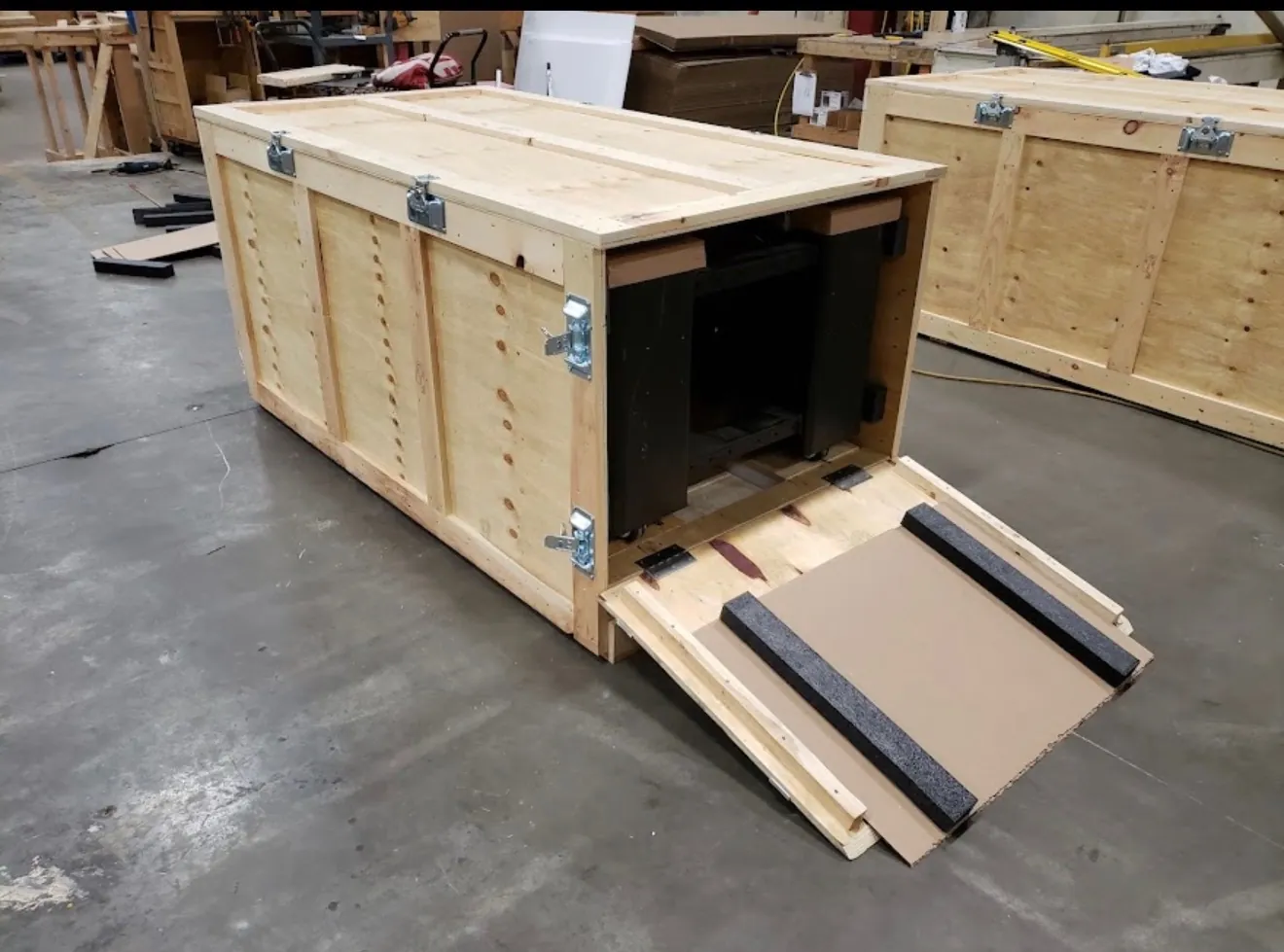
Some pieces need more than layers. A custom crate is built around a piece when its structure, its journey, or its value asks for a rigid shell: a piece too fragile or unstable to travel in blankets alone, a piece traveling as freight or over a long distance, a framed work whose face must never be pressed, or a piece whose value leaves no room for contact, shifting, or a dropped corner. The crate is carpentry, not packaging tape: the piece is measured, the crate is built to it, the interior is foam-lined and braced, and the piece is secured inside so the load cannot move against the walls that protect it.
Museum practice builds the same thing for the same reason, as a package within a package: the object is packed and cushioned first, then floated inside an outer crate with cushioning on all sides — the National Park Service crating method allows two to three inches on all sides for that cushioning, in a plywood crate made to barrier against water, absorb low-level vibration and high-impact blows, and facilitate easy handling (5). The lid is screwed, not nailed, because hammering stresses what is inside (5). The Smithsonian Museum Conservation Institute's travel box for paintings works on the same principle at a smaller scale: the painting is secured so packing takes very little direct handling, conservation-grade foam at the base absorbs shock and vibration, and the box itself can be placed inside a crate when the journey demands it (4).
When a journey crosses borders, the crate is built as export packing. Our packing service works to the ISPM 15 standard for wood packaging in international trade — the phytosanitary standard the Canadian Conservation Institute's transport bulletin also treats as the governing rule for wooden crates crossing borders (3) — so a crated piece leaving the country travels in a crate built for that crossing from the start.
Heavy antiques under SIR
Most antiques are threatened by fragility, not by weight. A smaller class is threatened by both. An antique safe, a large stone or marble piece, a monumental clock, or a piano that has crossed into true high mass can weigh as much as the heaviest work this company does — and when a high-value piece reaches the 1,500 to 3,500 lb band, it stops being only a packing problem and becomes a structural one.
Those pieces are planned under SIR, Structural Integrity Relocation, and the KIM-GS Protocol, the same protocol that governs the gun safe in today's paired flagship, how a gun safe is moved. The survey weighs the piece and maps the route, and the floor-deflection analysis referencing L/360 checks whether the floors along that route — and at the placement point, which may carry the load for years — can take the concentrated weight. Floors, stairs, and thresholds are protected before the piece crosses them, and the piece moves only on the route the analysis supports.
Antique safes and pianos are the familiar examples. An antique safe combines both disciplines in one object: a finish, hinges, and fittings that need antique care, wrapped around a mass that needs structural planning, and a piece the customer empties before it is handled. A concert-scale piano or a stone-topped antique can present the same pairing at lower weight, which is why the survey — not the category — decides whether SIR applies. Below the band, the piece gets the same surveyed route and protection discipline. In the band, the full protocol comes first, and the packing and structural plans are made together, as one job.
How the job works
1. Name the pieces. The quote starts with the pieces themselves: tell us what is moving — each antique, framed work, or museum piece — and the stairs, turns, and narrowest points at both addresses. A piece named in the scope is planned as a piece; a piece discovered on move day is a problem the survey exists to prevent.
2. Survey and assessment. Each piece is assessed on its own — weight, dimensions, fragile points, finish, condition, and value at risk — and the route at both addresses is measured with it. Existing damage, loose parts, and earlier repairs are noted while the packing is planned, and pieces in the 1,500 to 3,500 lb band are identified here, so SIR planning and floor-deflection analysis happen before anything moves.
3. Packing matched to the piece. Each piece is packed in layers set by its survey: soft wrap against the surface, paper padding worked into its shape, moving blankets as the working cushion, and foam support where the shape needs it. Parts that can be separated safely are wrapped separately. A piece that needs a rigid shell is measured for its custom crate here, and a piece crossing a border is crated as ISPM 15 export packing.
4. The move. Pieces travel on the planned route, floors and door frames protected before a piece crosses them, each piece secured so nothing shifts in transit and supported at its strongest parts. A crated piece travels in its crate, loaded so the crate — not the piece — takes the handling. Equipment varies by project and is chosen for the pieces and the route in front of us, never from a fixed list.
5. Placement verified. At the destination, each piece is brought in on the planned route, set where it belongs, unwrapped or uncrated, and placement and condition verified with you before the crew leaves — never left at a curb. A piece that traveled dismantled or crated is made whole as part of placement.
An irreplaceable piece should never travel on an open-ended price. Get a flat rate quote — name the pieces and the two addresses, and the full job is reviewed and priced in writing before move day.
Risks, and how they are controlled
The risks in moving an antique or a museum piece are known, and each one has a control. The Canadian Conservation Institute lists the main concerns for a fragile shipment plainly: shock and vibration; punctures, dents, and abrasion; impact and distortion; strain and compressive forces during handling, storage, and transport; and environmental hazards such as incorrect temperature and humidity, water, pollutants, and pests (2). Its transport research adds that handling is where the exposure concentrates — pickup, delivery, loading, and unloading place the greatest demands on a package, ahead of the road itself (3).
Shock and vibration are controlled by cushioning matched to the piece and by restraint: the piece cannot strike anything if it cannot move, and the foam and padding around it absorb what the road delivers. For high-value or highly fragile items, the Institute's guidance calls for thicker cushioning — 50 mm, about two inches — even on a controlled door-to-door journey (2). Abrasion is controlled at the surface, by the soft wrap that keeps cushioning and straps off the finish. Puncture and impact are controlled by the outer layer — blankets for a household journey, a rigid custom crate where the journey or the piece demands a shell (3, 5).
Environmental risk is controlled by planning, not hope. Typical packaging buffers a sudden temperature change for only about thirty minutes to several hours, and where temperature-controlled transport is required, the Institute gives the standard specification as reliable control in the range of 15°C to 25°C, 59°F to 77°F (2). Those are the museum benchmarks a careful plan respects when it sets timing and route. Handling risk is controlled the oldest way there is: treat every piece as if it were irreplaceable and the most valuable piece in the collection, handle it only when necessary, move one piece at a time, and never hurry (1). That is the National Park Service's first handling rule, and a fair summary of this whole service.
What we do not do is as plain. We do not restore, repair, or appraise antiques, and we do not offer museum institutional terms: condition reports and courier accompaniment are not claimed. Noting a piece's condition while its packing is planned is ordinary care, and it is as far as that goes. A piece that needs a conservator needs a conservator, arranged by the owner. The same care continues after placement in today's paired post, white-glove delivery, step by step, which follows a high-value delivery into its room.
What affects cost and timing
There are no published per-piece prices here, because the honest price is set by the scope, so the factors are the scope itself: how many pieces are moving and what each piece is — its size, weight, materials, condition, and value at risk; the packing each piece needs, from layered blankets to foam support to a custom crate built around it; whether a piece reaches the 1,500 to 3,500 lb band and takes SIR planning and floor-deflection analysis; the stairs, turns, and narrowest points at both addresses, and the floors that need protection; whether the journey is across town, a long-distance run, or an export move in ISPM 15 crating; and the distance and timing the route requires. Crating and export packing are built before move day, so a crated or export job is scheduled around the build as well as the move. Once those facts are in, the whole job is reviewed in full and priced at one flat rate in writing — the price you agree is the price you pay. Hourly pricing is available when a client asks for it.
Where we work
Antique and museum-piece moving is dispatched from both branches, and the branches stay distinct. Winchester: The Flat Rate Movers, 116 W Piccadilly St Suite 11, Winchester, VA 22601 — Mon–Fri 8–6, Sat 8–4, Sun 9–4. Martinsburg: Flat Rate Movers Martinsburg WV, 736 Williamsport Pike Suite 2, Martinsburg, WV 25404 — Mon–Fri 9–6, Sat 9–4, Sun 9–4. Together the branches serve a footprint of 87 areas — 56 from Winchester and 48 from Martinsburg, with 21 areas shared — running primarily along the I-81 corridor, with I-66 and I-70 connecting. Both branches answer on the same phone, +1-540-422-2153. The full service, with its complete question set, lives on the piano, antique and white-glove moving page.
Frequently asked questions
How are antiques and museum pieces packed for a move?
Each piece is surveyed first for weight, fragile points, finish, and condition, then protected in layers matched to that piece. A soft wrap goes against the surface, paper padding and moving blankets cushion it, and foam adds support where the shape needs it. Pieces that need more protection travel in a custom crate built around them.
When does an antique need a custom crate instead of blankets?
A piece needs a custom crate when blankets and padding alone cannot control its risks: a fragile or unstable structure, a long or freight journey, a border crossing, or a value that leaves no room for contact or shifting. The crate is measured and built around that one piece, lined and braced so the piece cannot move inside it.
Do you move museum pieces, or only household antiques?
Both. Museum-item moving is a confirmed service of this company, handled under the same piece-by-piece discipline as household antiques: survey, packing matched to the piece, custom crating when required, careful transport, and verified placement. High-value work is scheduled discreetly and no client is ever named. Museum institutional terms, such as condition reports and courier accompaniment, are not claimed.
What happens with a very heavy antique, like an antique safe or a piano?
A high-value piece that reaches 1,500 to 3,500 pounds is planned under SIR, Structural Integrity Relocation, and the KIM-GS Protocol before it moves. That work includes a floor-deflection analysis referencing L/360, so the floors and route are checked for the load as carefully as the piece itself. Antique safes and pianos are the familiar examples of pieces planned this way.
How do you protect a piece with loose, flaking, or fragile parts?
The survey notes loose joints, flaking surfaces, weak legs, and fragile projections before anything is wrapped, because those points decide how the piece is supported and where hands and straps may go. Projections are never used as handles. The packing supports the strongest parts, cushions the vulnerable ones, and keeps pressure off faces and finishes that cannot take it.
Can an antique or museum piece travel across a border or overseas?
Yes, when the journey crosses borders the piece is export packed. Custom crating for export is built to the ISPM 15 standard for wood packaging in international trade, and the piece is secured inside its crate so it travels as freight with the same survey, packing, and placement discipline used on a domestic move, planned as one scope from the start.
What does it cost to move an antique or museum piece?
There is no per-piece price list, because the honest price depends on the scope: the piece and its condition, the packing or custom crate it needs, the stairs and floors at both addresses, and the distance it travels. Once the scope is reviewed in full, the job is priced at one flat rate in writing. Hourly pricing is available when a client asks for it.
Who packs the piece, and do I need to empty or prepare it first?
Our packing service does the wrapping, padding, blanketing, and crating as part of the planned job, so each piece is protected by the same plan that moves it. You help most by naming every piece in the scope before move day, pointing out known damage, loose parts, or earlier repairs, and keeping the planned route clear at both addresses.
Sources
- Museum Handbook, Part I, Chapter 6: Handling, Packing, and Shipping — National Park Service, https://www.nps.gov/subjects/museums/upload/MHI_Ch6_HandlingPackingShipping.pdf (accessed November 4, 2026)
- Five Steps to Safe Shipment, CCI Notes 20/3 — Canadian Conservation Institute, https://www.canada.ca/en/conservation-institute/services/conservation-preservation-publications/canadian-conservation-institute-notes/five-steps-safe-shipment.html (accessed November 4, 2026)
- Features of Effective Packaging and Transport for Artwork, Technical Bulletin 34 — Canadian Conservation Institute, https://www.canada.ca/en/conservation-institute/services/conservation-preservation-publications/technical-bulletins/effective-packaging-transport-artwork.html (accessed November 4, 2026)
- Adapting Sustainable Practices to Art Transit — Smithsonian Museum Conservation Institute, https://mci.si.edu/adapting-sustainable-practices-art-transit (accessed November 4, 2026)
- Crating Museum Objects for Shipment, Conserve O Gram 17/3 — National Park Service, https://npshistory.com/publications/curation/conserve-o-grams/17-03.pdf (accessed November 4, 2026)
Get your flat rate
One flat rate in writing before move day, for the full scope — every piece named, packed, and planned. Guaranteed Flat Rate or Your Move is Free!
Get My Flat Rate Quote · Or call +1-540-422-2153.
Start here
One flat price in writing before move day — hourly pricing is available when a client asks for it.
Call +1-540-422-2153 · ratemovers@gmail.com
Winchester VA — 116 W Piccadilly St, Suite 11 · Mon–Fri 8 AM–6 PM, Sat 8 AM–4 PM, Sun 9 AM–4 PM
Martinsburg WV — 736 Williamsport Pike, Suite 2 · Mon–Fri 9 AM–6 PM, Sat 9 AM–4 PM, Sun 9 AM–4 PM
Guaranteed Flat Rate or Your Move is Free!
Get My Flat Rate QuoteBy Henry Pitts Jr. — Reviewed by Henry Pitts, owner, The Flat Rate Movers.