
When an item needs a custom crate and when padding is enough
Padding protects a surface; a crate protects a structure. If a piece can be crushed, punctured, stacked on or shifted against — or if it is crossing an ocean — it needs a crate. If the real risk is scratches on a sturdy piece moving once, in one truck, padding is enough. The decision turns on the piece and the journey, not the price tag.
Get My Flat Rate Quote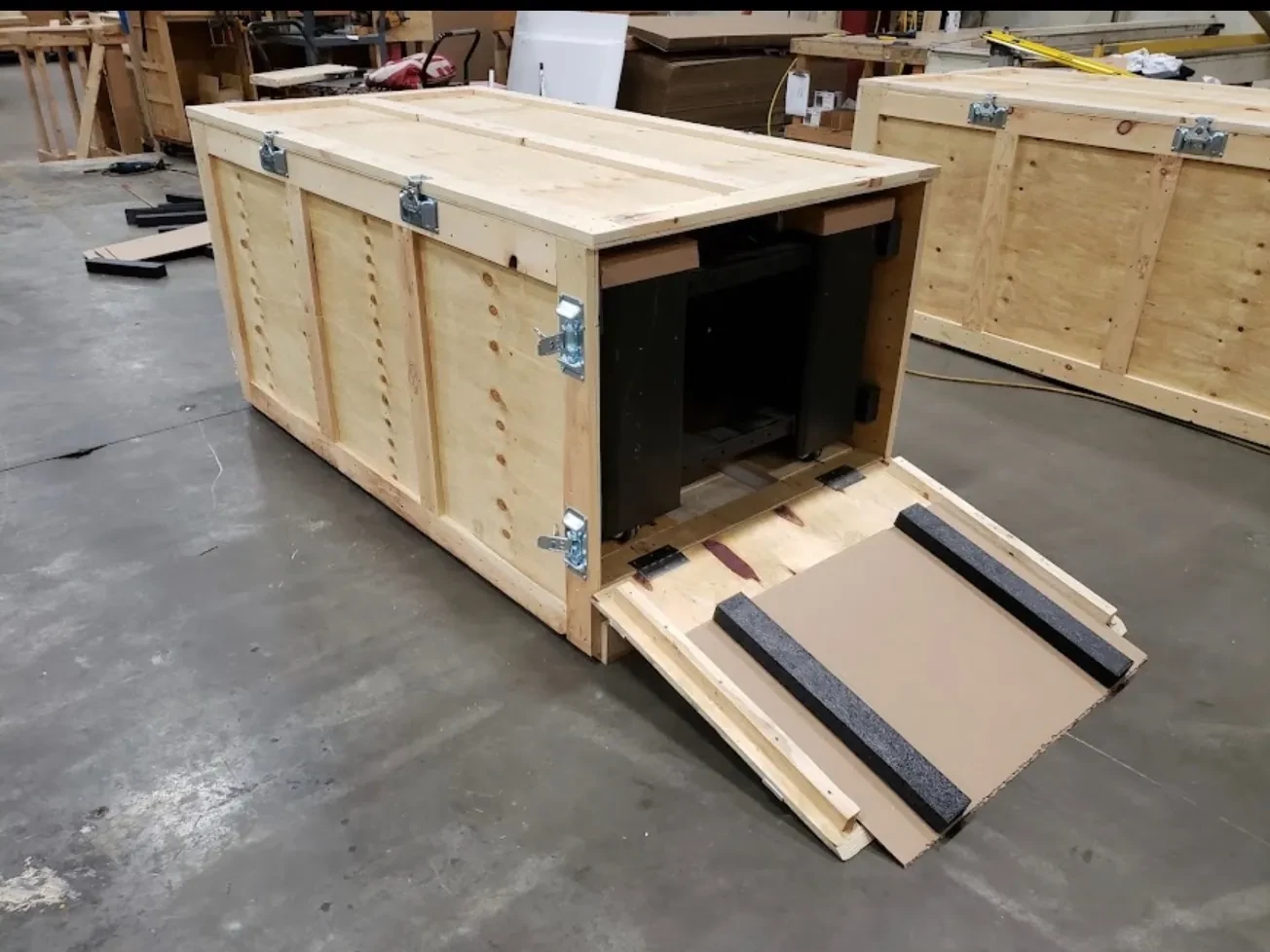
What is custom crating?
Custom crating means a crate built around one item — measured to that piece, not pulled from a stack of stock boxes. This Old House's moving guide puts the mechanism plainly: the crate is designed to match the item, creating a snug, secure fit that prevents the shifting that causes damage in transit, where standard packing offers no custom-built protection at all (1). Inside, the piece is blocked, braced and cushioned so it cannot move (7).
When does a piece need a crate?
Five triggers, and any one of them settles the question:
1. The structure is the fragile part. Thin glass, stone tops, delicate carvings and fine finishes fracture under stress padding cannot absorb — the pieces guides list as crating-required, not optional (3). 2. The journey has hand-offs. Freight transferred between vehicles or terminals is forklifted and stacked at every touch. uShip's crating guide is blunt: for less-than-truckload freight, crating is not just helpful, it is expected — the crate absorbs the impacts of repeated handling (2). 3. The shape defeats padding. Oversized or irregular pieces cannot be anchored with straps and pads alone; carriers insist on a frame around them (3). 4. The piece is crossing a border. International legs add handling, humidity and long transit — and the crate's wood itself becomes regulated (3, 4). 5. The piece is going into storage. Months in a warehouse mean stacking pressure and contact from other freight; a wrapped piece takes those knocks directly (3).
Value sharpens every trigger — a piece worth far more than it weighs is the classic case (3).
When is padding enough?
Padding earns its keep when the threat list is short — it handles abrasion and minor impact, and nothing more: it cannot carry a load stacked on it, stop a puncture, or fix a piece against a shifting load. Our published protection model starts every piece the same way — wrapped first, white-glove wrapping for antiques, art, instruments and fragile pieces, padding at every contact point (7). That layer, plus blankets and stretch wrap, is the complete answer when:
- The piece is sturdily built and its exposure is surface-level — scratches and scuffs.
- One crew carries it once, in one truck — no terminal, no stacking, no second carrier. uShip's own contrast is a local sofa: shrink wrap and padding (2).
- The destination is a room, not a warehouse shelf — placed the same day.
The honest middle exists too: a standard mirror travels in a mirror carton, and medium-value fragile furniture can be double-boxed where a crate is recommended but not required (3). The line: would a failure be a scuff — or a fracture?
The decision, piece by piece
| The piece and the journey | Padding enough? | Why |
|---|---|---|
| Sturdy furniture, local move, one truck | Yes — blankets and stretch wrap | Surface risk only; no stacking or hand-offs (2, 7) |
| Standard framed mirror or art, carried once | Usually — mirror carton and padding; crate if oversized or antique-framed | Cartons fit standard sizes; scale changes the answer (3) |
| Original artwork, sculpture, irreplaceable antique | Crate | Irreplaceable; insurers often require crating (3) |
| Glass or stone tabletop | Crate | Fractures under point stress padding cannot carry (3) |
| Machinery part or equipment with a freight leg | Crate | Forklift handling and stacking at every transfer (2, 7) |
| Anything crossing a border in solid wood packaging | Crate built to ISPM 15 | The wood itself is regulated: treated and marked (4, 5) |
| A fragile piece going into months of storage | Crate | Stacking pressure and warehouse contact over time (3) |
How much does custom crating cost?
Third-party figures first, labeled as context. One national moving guide's illustrative comparison puts boxes and specialty cartons at $5 to $50 per item and custom crating at $150 to $1,000 or more per crate, varying by market, size and complexity (3). This Old House gives no flat figure — cost varies with materials, size and conditions — and frames crating against the alternative: more up front, still cheaper than an expensive repair or replacement (1). We publish no per-crate price list: crating is quoted per job, inside the scope it belongs to, at one flat rate in writing (7).
Does an export crate play by different rules?
Yes — the wood becomes part of the regulation. ISPM 15 (International Standards for Phytosanitary Measures No. 15) governs solid wood packaging in international trade. As administered in the United States, heat treatment means the wood core reaches a minimum of 56 degrees Celsius for at least 30 minutes (4, 5). USDA APHIS describes the compliant routes: build from previously heat-treated lumber carrying an accredited agency mark, or heat-treat the finished packaging and apply the mark (4).
Three practical consequences:
- The treatment codes are specific. Approved treatments include heat treatment (HT), methyl bromide fumigation (MB), sulfuryl fluoride fumigation (SF) and dielectric heating (DH); pressure-treated lumber does not qualify unless heat-treated and stamped first (5).
- Some materials are exempt by construction. Plywood, oriented strand board, particleboard, flakeboard and veneer sit outside the requirement — their manufacture already involves high heat — as does wood 6 mm or thinner (5). A crate's solid-wood frame and skids are not exempt; they are the regulated part.
- Non-compliance lands on the shipper. Our published export pages state it directly: wood packaging that does not comply can be delayed, treated at the shipper's cost, or refused (7). Our practice matches: export crates are built to ISPM 15 from compliant, heat-treated, marked wood (7).
Example (illustrative): an antique marble-top sideboard is sold from a Valley estate to a buyer overseas. The piece is surveyed and measured; the marble and carved frame are wrapped first; a crate is built around it — around its weight, fragile points and center of mass — its interior blocked, braced and cushioned so nothing can shift. Because the shipment crosses a border, the crate's solid wood is compliant, heat-treated and marked. The closed crate travels the export chain — I-81 south, I-64 east to the Port of Virginia's Hampton Roads terminals — inside the one flat rate quoted for the job.
What we do for you
The Flat Rate Movers builds crates around the pieces that need more than padding — antiques, artwork, machinery parts and high-value equipment; for export, also pianos, instruments, and medical and sensitive equipment (7):
1. Name the pieces. Tell us the pieces in the Detailed Project form, or use the video walkthrough — film the piece where it stands; we never ask you to lift, move or open anything for the camera. 2. Survey and measure. Each piece is surveyed and measured; the crate is designed around its weight, fragile points and center of mass (7). 3. Wrap before wood. The item is packed first — white-glove wrapping, padding at every contact point — before any wood is closed around it (7). 4. Build and fit the interior. Inside the crate the item is blocked, braced and cushioned so it cannot shift in transit (7). 5. Close, mark and document. The closed crate is documented with the piece, its weight and its handling needs, and joins the move or the export chain — load, transload and final mile under one roof (7).
Heavy pieces are planned, not improvised: a piece in the 1,500 to 3,500 lb band is planned under SIR, our method, and the KIM-GS Protocol, with the floor check referencing L/360 — its crating scoped inside the same written flat-rate job (7). What we do not do: sell a stock box as a custom crate, or claim an engineering certification or load rating for a crate (7).
A crate is a small building for one irreplaceable thing. Get a flat rate quote and the pieces that need crates are surveyed, measured and scoped into the one flat rate, in writing, before move day.
From the Valley to the Port of Virginia
Crating for export is where our geography works. A crate built in the northern Valley reaches the ocean through the Port of Virginia's Hampton Roads terminals — the port publishes the deepest and widest harbor on the U.S. East Coast, five ultra-large container vessel berths, and two-day reach to 75 percent of the U.S. population (6). The Valley also holds the port's inland terminal, the Virginia Inland Port at Front Royal, where crated freight enters the port system without first traveling to the coast (7). Crating is dispatched from both home bases — Winchester, The Flat Rate Movers, 116 W Piccadilly St Suite 11, and Martinsburg, Flat Rate Movers Martinsburg WV, 736 Williamsport Pike Suite 2 (7).
Frequently asked questions
What is custom crating?
Building a rigid wooden crate around one specific item, measured to that item, with the piece secured inside by blocking, bracing and cushioning so it cannot shift in transit (7). Packing wraps an item in flexible protection; a crate gives it a rigid shell freight systems can stack and forklift (1, 2).
How much does custom crating cost?
Published third-party guides put custom crating at roughly $150 to $1,000 or more per crate, against $5 to $50 for boxes and specialty cartons, with size, materials and complexity driving the figure (3). We publish no per-crate price: crating is scoped per job and quoted inside the one flat rate in writing (7).
Can a custom crate be reused?
Often, yes. This Old House notes that many custom-built crates are reusable, spreading the build cost across future moves (1). Whether a crate suits a second journey depends on its construction and the next piece — reuse is settled when the next job is scoped, not assumed.
Does an export crate need heat-treated wood?
For its solid wood components, yes. ISPM 15 requires solid wood packaging in international trade to be treated — heat treatment: a core temperature of at least 56 degrees Celsius held for 30 minutes — and marked (4, 5). Plywood and oriented strand board are exempt (5). Our export crates are built to ISPM 15 from compliant, heat-treated, marked wood (7).
What is the difference between a crate, a pallet and a skid?
A skid is a base — runners that carry a load and let a forklift underneath; a pallet is a flat deck on the same principle. Neither has walls. A crate is the base plus an enclosure: panels and a lid that turn protection from a platform into a structure, its interior fitted so the piece cannot shift (7).
How long does it take to build a custom crate?
The build follows the survey: the piece is measured, the crate designed to its weight, fragile points and center of mass, the item wrapped, and only then is the wood closed around it (7). The sequence is scheduled when the job is scoped, ahead of move day. We publish no fixed lead time.
Sources
This Old House, "What Is Custom Crating?" — items that require crating, the snug-fit mechanism, reusability, cost framing — thisoldhouse.com/moving/what-is-custom-crating (retrieved 2026-10-30).
uShip, "The Ultimate Crating and Packaging Guide" — crating vs packaging, when crating is necessary, LTL handling and stacking — uship.com/blog/crating-and-packaging-guide/ (retrieved 2026-10-30).
United Local Movers, "When Crating Is Required vs Recommended" — required vs recommended situations, decision factors, the illustrative cost comparison — unitedlocalmovers.com/info/when-crating-is-required-vs-recommended-a-complete-guide-for-safe-moving (retrieved 2026-10-30).
U.S. Department of Agriculture, APHIS, "Export ISPM 15-Compliant Wood Packaging Material From the United States" — the treatment programs, the 56 °C / 30-minute core requirement, the accredited agency mark — aphis.usda.gov/plant-exports/wood-packaging-material/export (retrieved 2026-10-30).
NELMA, "Export Wood Packaging" — the approved ISPM 15 treatments (HT, MB, SF, DH) and the exempt composite materials — nelma.org/export-wood-packaging/ (retrieved 2026-10-30).
The Port of Virginia, "Our Future" — deepest and widest harbor on the U.S. East Coast, five ultra-large container vessel berths, two-day reach to 75 percent of the U.S. population — portofvirginia.com/the-future/ (retrieved 2026-10-30).
The Flat Rate Movers, Custom Crating datasets (operations, process chain, taxonomy, terms, boundaries) — theflatratemovers.com/datasets-crating.json (retrieved 2026-10-30).
Get your flat rate
One flat price in writing before move day — hourly pricing is available when a client asks for it.
Get My Flat Rate Quote → · Or call +1-540-422-2153.
*By Henry Pitts Jr. — Reviewed by Henry Pitts, owner, The Flat Rate Movers.*
📞 Start here
Phone: +1-540-422-2153 · Email: ratemovers@gmail.com
Hours by location — Winchester: Mon–Fri 8am–6pm · Sat 8am–4pm · Sun 9am–4pm. Martinsburg: Mon–Fri 9am–6pm · Sat 9am–4pm · Sun 9am–4pm. Winchester, VA: 116 W Piccadilly St, Suite 11, 22601 · Martinsburg, WV: 736 Williamsport Pike, Suite 2, 25404. Guaranteed Flat Rate or Your Move is Free!
By Henry Pitts Jr. — Reviewed by Henry Pitts, owner, The Flat Rate Movers.